
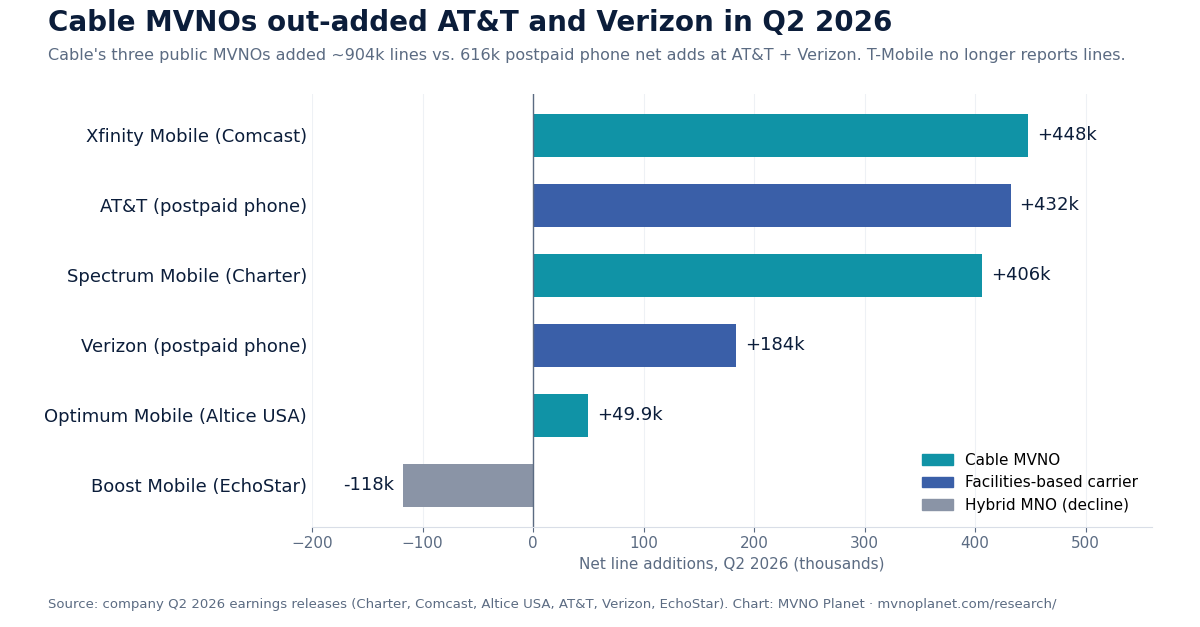
Key takeaway
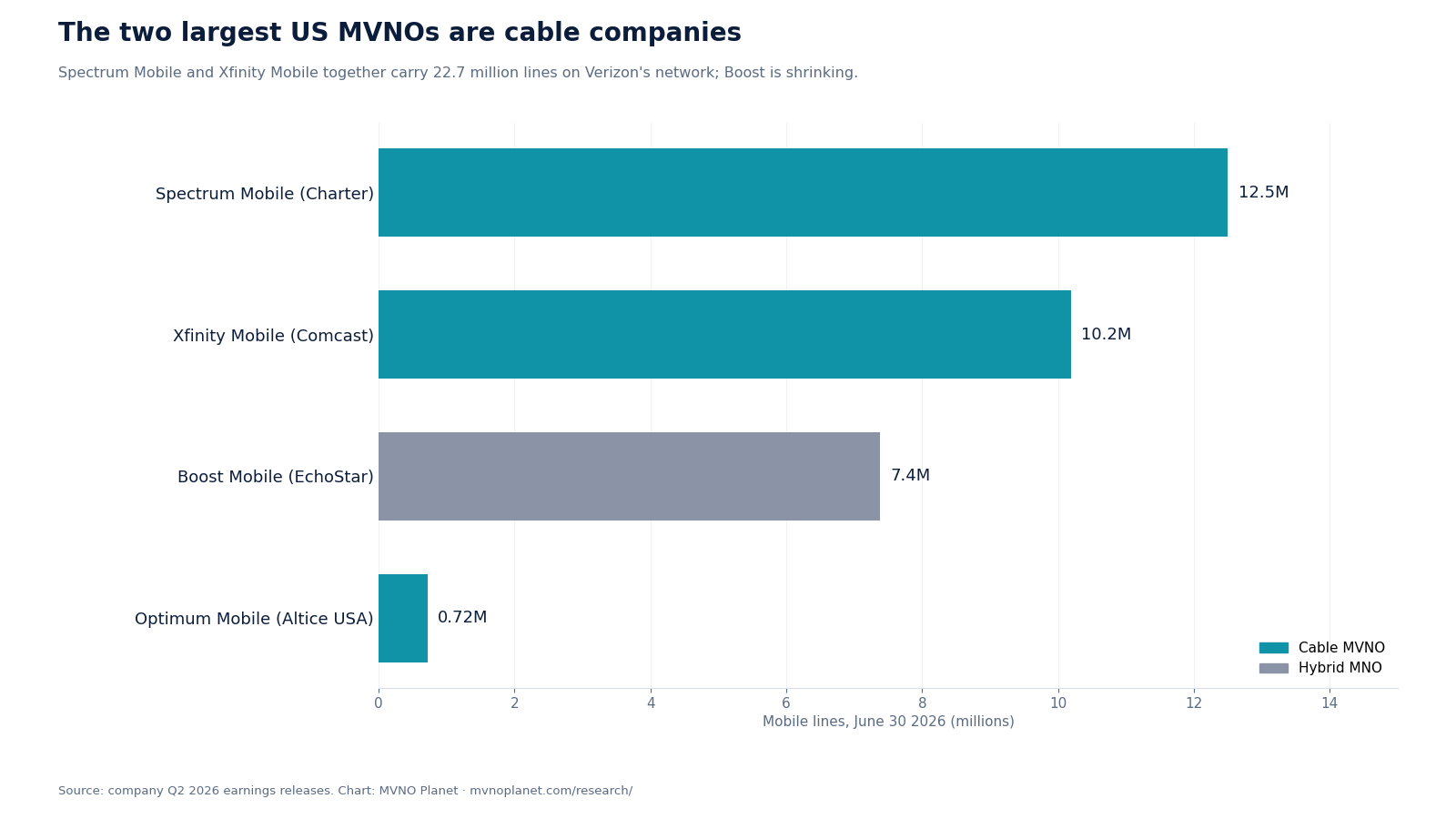
Cable’s three public MVNOs added roughly 904,000 mobile lines in the second quarter of 2026, more than AT&T and Verizon’s postpaid phone net adds combined (616,000). Xfinity Mobile’s 448,000 was a company record and beat every facilities-based carrier that still reports phone lines. Spectrum Mobile is now the largest MVNO in the country at 12.5 million lines, Boost Mobile shrank by 118,000, and T-Mobile stopped reporting line counts altogether, which makes cable’s numbers the cleanest read on US wireless share shift available.
This is the first edition of the MVNO Planet US MVNO Scorecard, which we will publish every earnings season. It tracks the mobile virtual network operators that disclose subscriber counts, sets them against the facilities-based carriers, and notes what changed in reporting. All figures are from company earnings releases for the quarter ended June 30, 2026; the data is downloadable below.
The scorecard
| Brand (parent) | Segment | Lines, June 30 2026 | Q2 2026 net adds | Host network |
|---|---|---|---|---|
| Spectrum Mobile (Charter) | Cable MVNO | 12.5 million | +406,000 | Verizon; T-Mobile (business) |
| Xfinity Mobile (Comcast) | Cable MVNO | 10.19 million | +448,000 (record) | Verizon; T-Mobile (business) |
| Boost Mobile (EchoStar) | Hybrid MNO | 7.38 million | −118,000 | AT&T and T-Mobile wholesale, own 5G core |
| Optimum Mobile (Altice USA) | Cable MVNO | 724,000 | +49,900 | T-Mobile |
| AT&T | Carrier (postpaid phone) | not comparable | +432,000 | own |
| Verizon | Carrier (postpaid phone) | not comparable | +184,000 | own |
| T-Mobile | Carrier | not reported | +277,000 postpaid accounts | own |
Cox Mobile (now part of Charter) and Astound Mobile do not disclose line counts. Carrier “lines” are postpaid phone net adds and are not directly comparable to cable’s total mobile lines, which include some tablets and watches; the comparison is directionally sound because phones dominate both.
What the quarter tells us
Cable’s mobile growth is decoupled from its broadband decline. Charter lost 172,000 internet customers and Comcast lost 167,000 in the same quarter they added 854,000 mobile lines between them. Charter’s mobile base is up 1.7 million lines, or 16%, in twelve months. Comcast’s own framing is that 10.2 million lines represents 17% of its residential broadband customers but only 7% of the total wireless lines in its footprint, which is the runway argument. Optimum, the smallest public reporter, grew mobile service revenue 40% year on year and pushed mobile penetration of its broadband base from 6.9% to 8.9%.
The free-line playbook is doing the work. Roughly half of Comcast’s recent postpaid connects took a free line; Charter is offering Cox internet customers a free mobile line for a year following the August 20 close of the Cox acquisition. Expect Q3 to show a Cox-driven step up in Spectrum Mobile adds, and expect the Q4 question to be how many of those free lines convert to paid.
The carriers changed the yardstick. T-Mobile now reports postpaid net account additions (277,000, down 13% year on year) rather than lines, and Verizon dropped the consumer/business split from its tables. Recon Analytics estimates Verizon’s retail postpaid accounts fell 132,000 in the quarter despite 184,000 postpaid phone net adds. AT&T’s 432,000 was its strongest wireless quarter in years, concentrated inside its fiber footprint (178,000 converged fiber-plus-phone customers added). When the incumbents stop reporting a number, it is usually because the number stopped being flattering; the cable operators’ totals are now the most consistent disclosure in the market.
Boost is the outlier. EchoStar’s retail wireless base fell by about 118,000 to 7.38 million, against a 212,000 gain in the year-ago quarter, as the company sold spectrum to AT&T and SpaceX and moved to a hybrid MNO model running its own core over AT&T’s radio network. Boost remains the largest non-cable virtual operator by a wide margin, but it is the only one in the table going the wrong way.
What to watch in Q3
- Spectrum Mobile’s first quarter including Cox markets, and whether Charter breaks out Cox Mobile’s contribution.
- Comcast Business Mobile and Spectrum Mobile for Business volumes on T-Mobile, the first dual-sourced quarter for the two largest MVNOs.
- Boost’s subscriber trend now that the AT&T network transition is under way.
- Whether any NCTC-member cable operator (Allo, Breezeline, TDS, Omni Fiber) starts disclosing mobile lines.
Data and citation
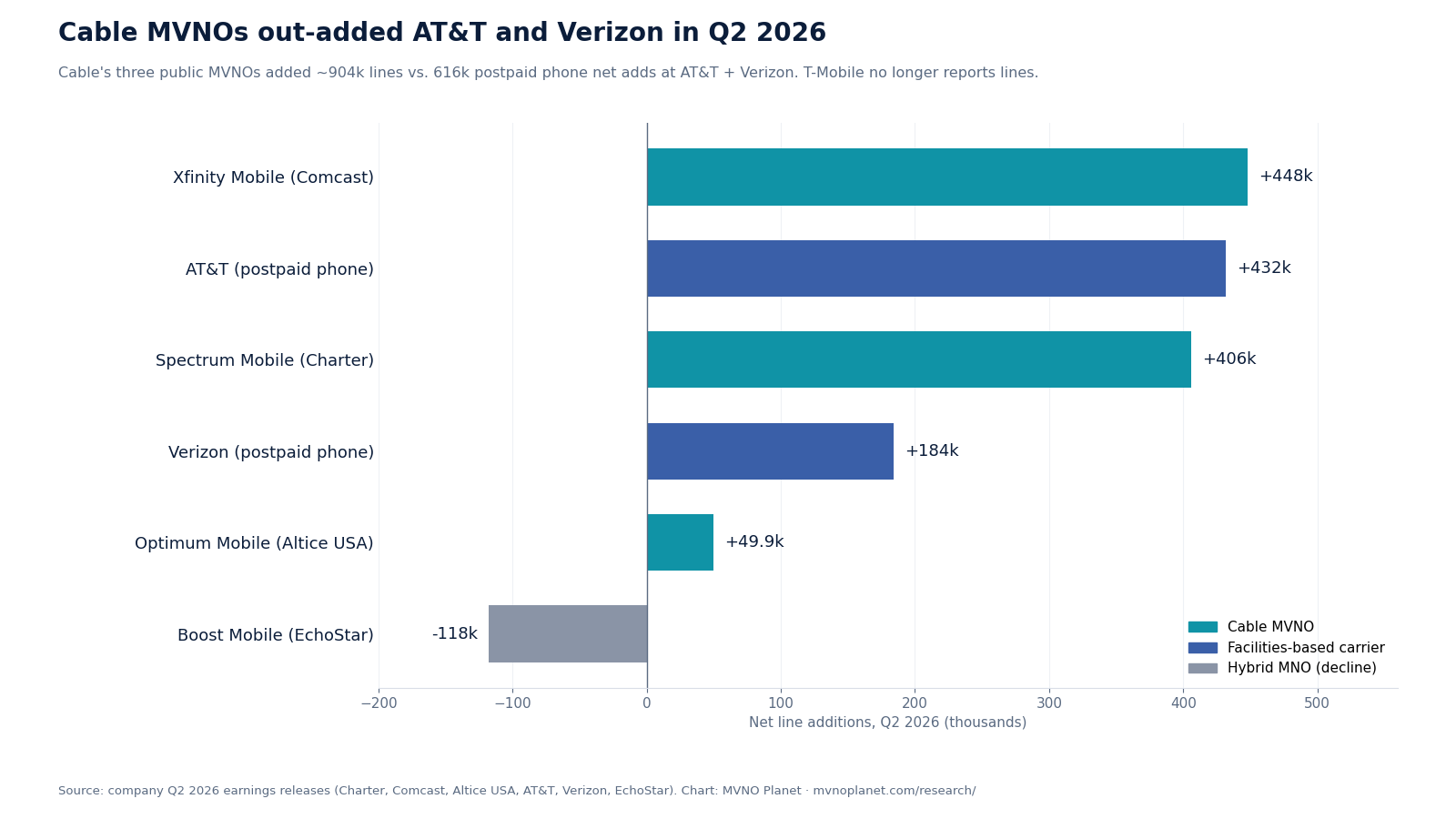
Download the underlying data: mvnoplanet-q2-2026-scorecard.csv. Charts are free to reuse with attribution; social-sized versions: net adds (1600×900), lines (1600×900).
Cite as: MVNO Planet, “US MVNO Scorecard, Q2 2026,” August 2026, https://mvnoplanet.com/us-mvno-scorecard-q2-2026/
Frequently asked questions
Who is the largest MVNO in the United States?
Spectrum Mobile, owned by Charter Communications, with 12.5 million mobile lines at June 30, 2026. Xfinity Mobile (Comcast) is second at 10.19 million and Boost Mobile (EchoStar) third at 7.38 million.
How many mobile lines did cable companies add in Q2 2026?
Charter, Comcast and Altice USA together added about 904,000 lines in the quarter: Xfinity Mobile 448,000, Spectrum Mobile 406,000 and Optimum Mobile 49,900. That exceeded the combined postpaid phone net adds of AT&T (432,000) and Verizon (184,000).
Why is T-Mobile missing from the scorecard?
Starting with its 2026 reporting, T-Mobile discloses postpaid net account additions (277,000 in Q2 2026) rather than line or phone net adds, so its figure is not comparable to the line counts in the table.
Where does the scorecard data come from?
From each company’s Q2 2026 earnings release and call: Charter, Comcast, Altice USA (Optimum), EchoStar (Boost), AT&T, Verizon and T-Mobile. The compiled dataset is available as a CSV download on this page.
How often is the US MVNO Scorecard updated?
Every earnings season, roughly four to six weeks after quarter end, once all reporting companies have published results.
Background on how the cable deals work: Cable MVNOs explained. Vendors serving cable and ISP mobile launches are in the directory.
Sources
Charter Q2 2026 results · Comcast Q2 2026 results · Optimum Q2 2026 results · EchoStar Q2 2026 results · AT&T Q2 2026 results · Verizon Q2 2026 results · T-Mobile Q2 2026 results · Recon Analytics on Q2 2026 reporting changes · Fierce: AT&T Q2 · Fierce: Charter closes Cox